_edited.jpg)


Find a Trusted Notary for Power of Attorney Today

Updated: Oct 10
Here's a hard truth about Power of Attorney documents: without a notary's seal, it’s often just a piece of paper with good intentions. In most states, the law is clear—you absolutely need a notary for power of attorney to make it legally binding. This isn't just a suggestion; it's the critical step that breathes legal life into the document.
Why Your Power of Attorney Needs a Notary

Think of notarization as the official act that activates your Power of Attorney. A notary public is a state-commissioned, impartial witness whose entire job is to prevent fraud. They do this by verifying your identity and confirming that you’re signing the document knowingly and without any pressure.
Without that official verification, institutions like banks, hospitals, or government agencies have no real proof the document is legitimate. They'll almost certainly reject an un-notarized POA, which can create heartbreaking delays right when your chosen agent needs to step in and act for you.
A notarized signature on a POA isn't just a bureaucratic formality; it's a powerful safeguard. It creates a formal record that the principal was of sound mind and not under duress, protecting the integrity of their wishes.
Understanding the Key Players
To really get a handle on the process, it helps to know who’s involved. It’s a pretty straightforward cast of characters, each with a clear job to do.
Let's quickly break down the roles you'll encounter during the notarization of your Power of Attorney.
Role | Who They Are | Primary Responsibility |
|---|---|---|
Principal | This is you—the person granting the power. | Signing the POA document in the presence of the notary. |
Agent (or Attorney-in-Fact) | The trusted person you appoint to act for you. | Carrying out the duties specified in the POA once it's active. |
Notary Public | The state-licensed official. | Verifying the principal's identity, witnessing the signature, and applying their official seal. |
Once you understand these roles, the entire appointment feels much less intimidating and more like a simple, logical procedure.
The need for this service is so essential that it has fueled significant growth in convenient options. For example, the mobile notary service market, which handles countless POA signings, was valued at USD 0.4 billion and is projected to climb to around USD 0.7 billion by 2033.
Taking a moment to grasp the importance of a notary public for legal documentation is the first real step toward creating an effective POA that will actually work when you and your family need it most.
Getting Your POA Ready for Notarization
When you’re getting a Power of Attorney notarized, showing up prepared can be the difference between a quick five-minute signature and getting turned away. A little prep work makes the whole process faster and, most importantly, legally sound. It saves you from the frustration of having to start all over.
I’ve seen this happen countless times: someone walks in with a document they’ve already signed. This is the biggest no-no. Do not sign or date the document beforehand. The entire point of notarization is for the notary to physically witness you signing the paper. If it’s already signed, they can't do their job, and the document is void for their purposes.
Another classic snag is expired ID. It’s an easy detail to overlook, but a notary has to verify who you are with a valid, government-issued photo ID. An expired driver's license just won't cut it.
Your Pre-Notarization Checklist
Before you head to your appointment, a quick once-over on these key items will ensure everything goes off without a hitch.
Fill It Out, But Don't Sign: Go through the POA form and fill in every single required field—names, addresses, the powers you're granting—but leave the signature and date lines completely blank. Accuracy is key, so double-check for any typos.
Know Your Witness Rules: Some states, like Florida, require one or two witnesses to be present in addition to the notary. This is a common requirement for POAs, so check your local state laws. If you need witnesses, make sure they come with you and bring their own valid IDs.
Bring the Right ID: This is non-negotiable. You'll need a current, unexpired government-issued photo ID. Think driver’s license, state ID card, or a passport.
A rejected notarization isn't just an inconvenience; it can create serious delays when you really can't afford them. Taking a few minutes to review your state's requirements and your own paperwork is the best way to prevent this common problem.
Getting these details right from the start turns the notarization itself into a simple formality. You'll not only respect the notary's time but also walk away confident that your Power of Attorney is properly executed and ready to serve its purpose.
Choosing the Right Notary Service for Your Needs
Getting a power of attorney notarized used to mean a trip to a bank or a local office. Thankfully, those days are over. Today, you have flexible options that fit your specific circumstances, location, and timeline. The two main paths you'll likely consider are hiring a mobile notary or using a Remote Online Notarization (RON) service.
Let's break down what each one offers so you can make the best choice.
Mobile Notary: A Human Touch at Your Doorstep
Think of a mobile notary as a house call for official documents. They travel to you—whether that's your home, your office, a hospital room, or even a coffee shop.
This service is a lifesaver in situations where the person signing the POA has mobility issues. For instance, if your elderly parent is in an assisted living facility, coordinating a trip out can be a major, stressful ordeal. A mobile notary eliminates that entire headache by coming directly to them.
The personal touch here is invaluable. A good mobile notary can create a calm, comfortable environment, patiently guiding the signer through the documents. It makes a potentially intimidating process feel much more human. To get a better sense of how it works, you can read about how mobile notaries make document signing easier.
Remote Online Notarization: Speed and Convenience from Anywhere
Now, let's look at another common scenario. Imagine you're in Las Vegas on a business trip, but you urgently need to grant a power of attorney for a real estate closing back in your home state. Flying back just for a signature isn't practical. This is exactly where Remote Online Notarization (RON) comes in.
RON uses secure audio-video technology to connect you with a commissioned notary in a virtual meeting. You can get your POA legally notarized in minutes from your laptop or smartphone, regardless of your physical location. It’s no wonder this technology is booming.
The global e-notary software market, the engine behind RON, was valued at USD 1.1 billion and is projected to hit USD 3.5 billion by 2032. Convenience is a powerful driver.
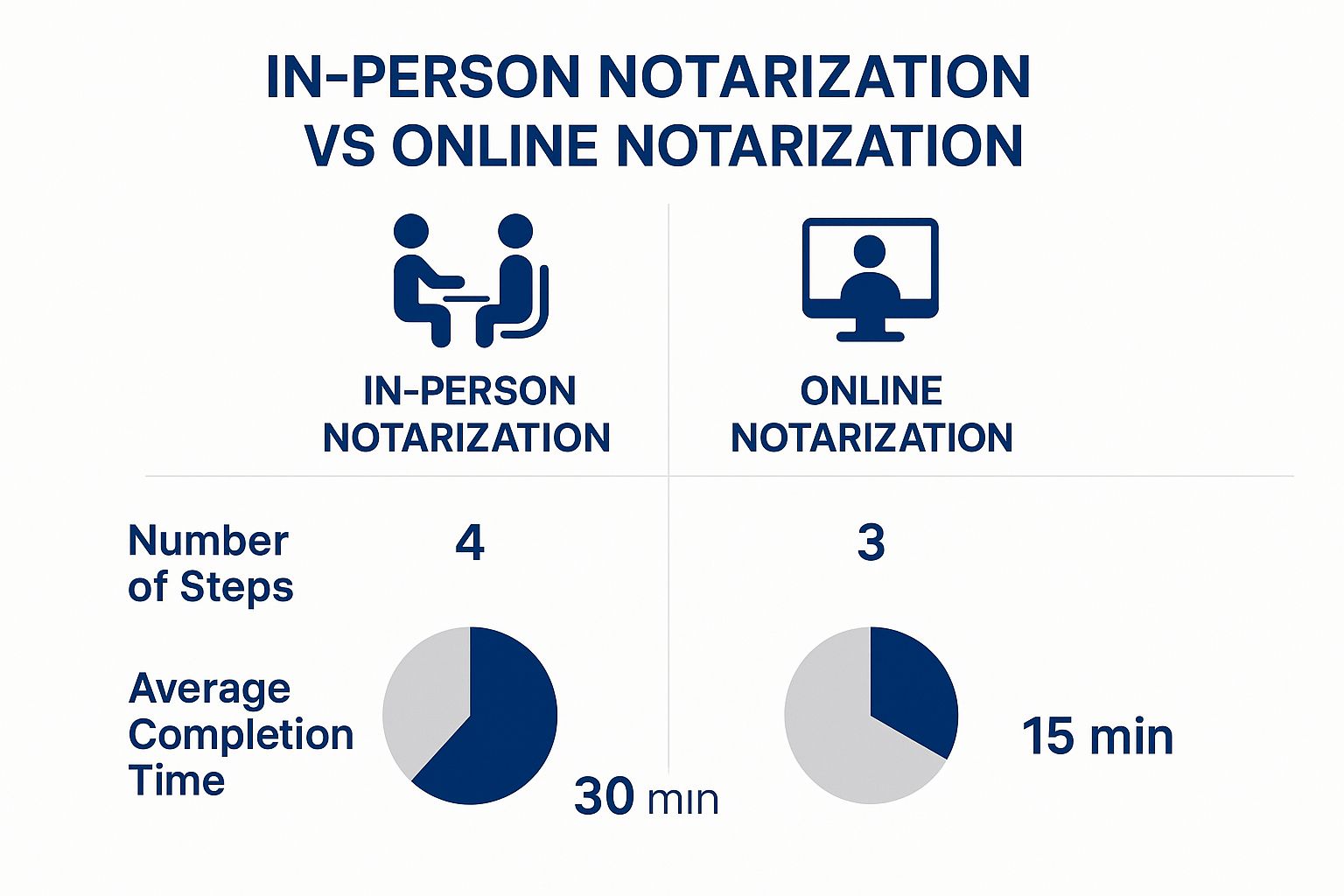
As you can see, going the online route can seriously cut down on the time and hassle involved.
Mobile Notary vs. Remote Online Notarization (RON)
Still not sure which way to go? This side-by-side comparison should help clarify which service is the right fit for your power of attorney.
Feature | Mobile Notary | Remote Online Notarization (RON) |
|---|---|---|
Location | In-person at a location of your choice. | Fully digital, from anywhere with internet. |
Best For | Signers with limited mobility, hospital patients, or those preferring face-to-face interaction. | Tech-savvy users, signers in different states/countries, and urgent last-minute needs. |
Scheduling | Requires scheduling an appointment in advance. | Often available on-demand, 24/7. |
Technology | No special technology is needed for the signer. | Requires a computer/smartphone with a camera, microphone, and stable internet. |
Personal Touch | High. The notary is physically present to guide the signer. | Lower. Interaction is through a screen. |
Ultimately, there's no single "best" answer—only what's best for you.
If the signer needs personal support or can't easily navigate technology, a mobile notary is the way to go. If speed, convenience, and bridging geographical gaps are your top priorities, RON is your most efficient option.
Both paths lead to a legally sound notary for power of attorney. The real advantage is that you now have the power to choose the one that makes the most sense for your life.
What Happens During the Notary Appointment
Getting a notary for power of attorney can feel a bit intimidating if you've never done it before. It’s natural to feel some anxiety, but knowing what to expect can make the whole thing much smoother. Think of it less like a stuffy legal proceeding and more like a carefully structured ceremony designed to protect everyone involved.
The first thing the notary will do, without fail, is verify your identity. This is the bedrock of the entire process. They’ll need to see a current, government-issued photo ID—like a driver's license or passport—and they will inspect it carefully. This step isn't just a formality; it's a legal requirement to prevent fraud.
Once they've confirmed you are who you say you are, the notary might ask a few simple questions. They aren't trying to get into your personal business. Their goal is simply to confirm that you understand the powerful document you're signing and that no one is forcing you to do it. It’s a quick check to make sure you’re signing willingly and with full awareness.
The Signing and Sealing Process
With the preliminary checks out of the way, it's time for the main event. You'll sign the power of attorney document right there, in front of the notary. Your signature must be witnessed by them.
After you've signed, the notary completes their part of the process, which involves a few key actions:
Completing the Notarial Certificate: They will meticulously fill out the notarial section on your POA, which states exactly what happened during the appointment.
Applying the Official Seal: Next comes the official stamp or embossed seal. This mark contains their name, commission number, and state, making the document official.
Making a Journal Entry: Finally, every detail of the notarization is recorded in the notary’s official journal. This creates a permanent, independent record of the signing.
Think of the notary’s journal as the official logbook for your document's signing. It serves as independent, third-party evidence that the notarization occurred properly, providing an essential layer of security and proof.
The demand for these services, especially convenient mobile and remote options, has skyrocketed. One recent market analysis valued the global mobile notary market at around USD 348.2 million and projects it will climb to an incredible USD 1,885.5 million by 2031. You can discover more insights about this growing market and its regional trends to see just how vital accessible notarization has become.
What to Do After Your Power of Attorney Is Notarized

The notary’s seal is on the page and your appointment is finished. You've just finalized a critical legal document, but the work isn't quite over. A Power of Attorney is pretty useless if it’s just tucked away in a filing cabinet. The next few steps are what actually give it power.
Your first priority is getting copies into the right hands. The original document is valuable, so you’ll want to store it somewhere very secure—think a fireproof safe or a bank's safe deposit box. But for your agent to actually use the POA, they need access to it. If they can't produce the document when the time comes, they can't legally act for you.
Giving out copies now prevents a frantic search during a crisis. The last thing you want is your agent scrambling for the original in an emergency. Giving them a certified copy ahead of time means they're ready to go when you need them most.
Who Gets a Copy?
So, who exactly needs to have this document? My advice is to think broadly about any person or organization that might need to see it. It’s far better to be over-prepared now than to run into frustrating delays later.
Here's a quick checklist of who should be on your distribution list:
Your Agent (and Successor Agents): This one is a must. They can't do anything without a copy to prove their authority.
Financial Institutions: Give a copy to your bank, credit union, and any brokerage firms you work with. This is what allows your agent to handle bills, investments, and other financial matters.
Healthcare Providers: If you have a medical POA, make sure your primary doctor, specialists, and the local hospital all have it on file.
Your Attorney: Your lawyer should always have a complete set of your executed estate planning documents in their records.
A Power of Attorney is a living document—it only works if the right people know about it and have access. Think of distributing copies as building the bridges your agent will need to cross on your behalf.
Taking these final steps ensures that the time you spent finding a notary for your power of attorney was worthwhile. You've officially equipped your chosen agent with the legal authority they need to protect your interests, whatever happens down the road. This is the final, crucial piece of the puzzle.
Common Questions About Notarizing a POA
Even with the best preparation, it's natural to have a few last-minute questions. Getting those sorted out before you meet the notary brings a lot of peace of mind. Let’s walk through some of the things people often ask when getting a notary for power of attorney.
One of the biggest worries I hear is, "Can the notary just refuse to sign my document?" The short answer is yes, they absolutely can—and for very important reasons. A notary has a legal duty to refuse the notarization if they can't confirm your identity, if you seem confused about the document's purpose, or if there's any hint of coercion. They aren't trying to be difficult; they're upholding the law to prevent fraud and protect you.
Cost and Who Needs to Be There
Cost is another big one. The actual fee for the notarial act itself is usually set by the state and can be pretty reasonable, sometimes just a few dollars per signature. What you're really paying for is the service and convenience. A mobile notary will include a travel fee, and a Remote Online Notarization platform will have its own service fee for using their technology. My advice? Always ask for the total cost upfront so there are no surprises.
So, who actually needs to show up for the signing?
The Principal: That's you, the person granting the authority. You must be present since it's your signature being notarized.
The Agent: Your chosen agent does not need to be there when you sign the POA. Their duties only kick in after the document is officially executed.
Witnesses: This is a big "it depends." State laws vary, and some require one or even two witnesses to be present during the signing.
The most important thing to remember is that the notarization is all about your signature. The notary's job is to verify who you are and that you're signing willingly, not to vet your agent.
Will My POA Work in Another State?
Finally, people often ask if a POA notarized in, say, California will be valid in Texas. In most cases, the answer is yes. The U.S. Constitution has a "full faith and credit" clause, which generally means legal documents properly executed in one state are honored in others.
But here's a real-world tip: some institutions, especially banks or real estate title companies in other states, can be sticklers and have their own internal rules. If you know your agent will be dealing with assets across state lines, it's smart to have them check with those specific organizations ahead of time. To really grasp why this process is so important, you can learn more by unlocking the power of notarization in our detailed guide.
When you need a professional, reliable, and convenient notary service, Signature on Demand is here to help. Whether you need a mobile notary to come to you 24/7 or the flexibility of Remote Online Notarization, we make the process simple and secure. Visit us at https://signatureondemand.net to schedule your appointment today.


Comments